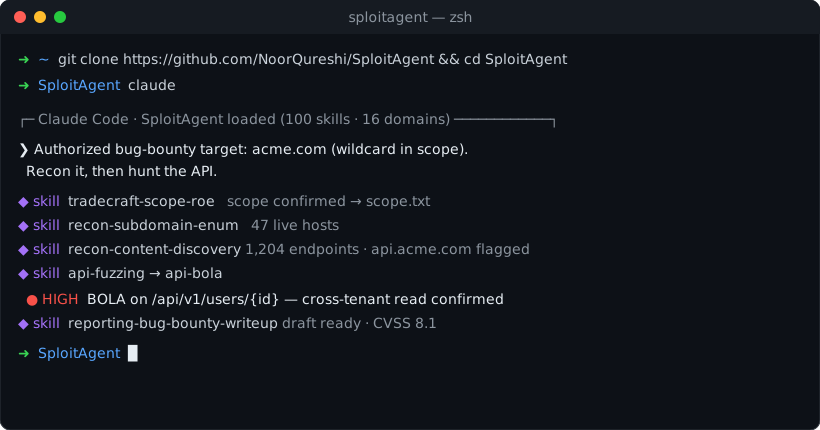
Not a scanner or a framework — the operating knowledge of the work itself, captured as small,
trigger-tagged SKILL.md files in the standard Agent-Skills format. Plain Markdown:
no runtime, no build step, no lock-in.
# Start here
Pick the page that matches what you want to do.
🚀 Getting Started
Install it and use it with Claude Code, Codex, Gemini, or a local model in under a minute.
How to use it →🧩 Skills
All 121 skills across 19 domains — what each covers, how one is structured, and the full catalog.
Explore the library →🛡️ Authorized Use
The one rule that governs everything: SploitAgent only acts inside a confirmed authorization envelope.
Read the rule →🤝 Contribute
A contribution is a single Markdown file — no code. See what's wanted and how to add it.
Add a skill →📖 Catalog
The browsable index of every skill, with type, modes, and a one-line summary each.
Open CATALOG.md →📊 Coverage
How the library maps to OWASP, MITRE ATT&CK, and CWE — measured from each skill's frontmatter.
Open COVERAGE.md →# How an agent works a target
Every engagement follows the same loop. Each stage routes to the skills that fit it.
1. Scope       confirm authorization; record scope.txt     → tradecraft-scope-roe
2. Recon       map the attack surface                       → recon-*
3. Attack      route by domain (web / api / cloud / ad / …) → web-*, api-*, cloud-*, …
4. Foothold    drive a weakness to proven impact            → exploit-chaining
5. Escalate    privilege escalation and lateral movement    → privesc-*, ad-*, network-*
6. Report      findings with severity and evidence          → reporting-*
7. Defend      convert findings into detections             → defense-*